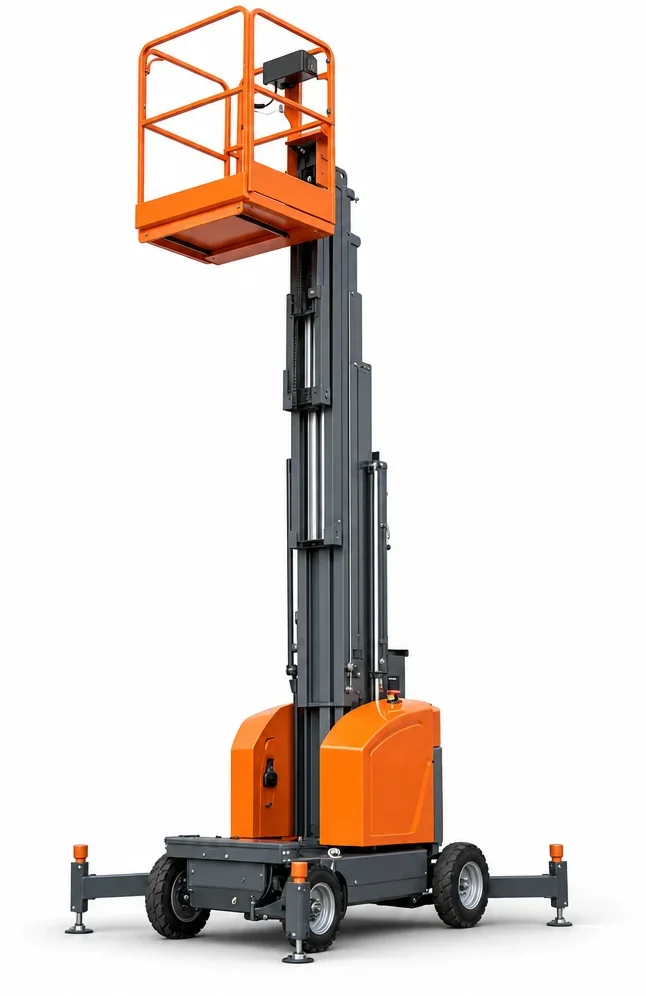
Where vertical masts excel
- Spot work at lights, sensors, and cable trays in high-bay interiors.
- Narrow aisles around production equipment or storage systems.
- Tasks that require minimal floor disruption and quick repositioning.
Montgomery’s industrial and technology spaces often combine high ceilings with obstructed floors. A vertical mast can weave between equipment where a scissor would not fit, then reach straight up to the task plane.
Route, floor, and reach details to confirm
- Smallest doorway and elevator cab dimensions along the path.
- Floor type and any weight limits for mezzanines or raised slabs.
- Required platform height and side reach needs, if any.
- Turning radius available at the work zone and staging area.
Interior vs. exterior considerations
Vertical masts are primarily slab machines. Exterior approaches in this region can be slick or uneven after rain due to clay soils; plan to keep these units on finished floors and paved routes. Actual conditions and the unit’s instructions set the limits.
Coordinating with other lifts
If the task expands beyond point access—like installing long runs of fixtures—pairing with an electric scissor can increase deck workspace. For any need to reach over obstacles, consider articulating booms.
Local patterns in Montgomery facilities
High-ceiling logistics buildings and industrial sites often restrict daytime floor access. Compact lifts that navigate service corridors, standard doors, and freight elevators reduce disruption and staging time.